Tags
A search for love, in all its glory,
Is central to our featured story.
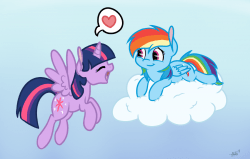 Racing Thoughts
[Romance] [Random] • 1,530 words
In a fantastical universe the bastard love-child of Edgar Allen Poe and T.S. Eliot got hooked on ponies.
The resulting poem, pulled through the void, is presented for your reading pleasure.
A (loosely) iambic tetrametric narrative of Twilight Sparkle struggling to understand, accept, and ultimately express, her love for Rainbow Dash.
FROM THE CURATORS: “When I start recommending poetry, you should stand up and take notice,” said Present Perfect, the RCL’s resident curmudgeon, as he brought this story to our attention. “This borrows heavily from the J. Alfred Prufrock school of poetry and excels for having done so. … It all comes down to ‘I hate poetry and I like this.'”
We did take notice — and it broadened our collective horizons, as Bradel affirmed. “This is probably the first pony poetry I’ve read,” he said. “It’s a lot better than I’d generally expect. The structure lends itself well to the stream of consciousness style, with meter and rhyme scheme shifting in a very natural way throughout the piece.” Chris agreed: “The pitter-pat flow came through clearly, and the mix of academic language and more conversational tone gave the poem a nice lilt, in addition to making it feel very Twilight.”
That mixture was used to good effect, drawing thoughts of yearning and lust out of a normally analytical character. The occasional suggestive turn of phrase was a distraction for some of us, but Bradel “found it very endearing. While it’s certainly not out of the ordinary for TwiDash fiction, it provides a few welcome twists in the flow of the poem.”
Overall, Racing Thoughts (which was originally posted as a single complete work, though unrelated poems have since been added to the story) was enjoyable for poetry fans and non-fans alike. As Present Perfect summarized it: “This guy can poetry. He can poetry good.”
Read on for our author interview, in which ambion discusses noble hobos, signs in the stars, and majestic and subtle ironies.
Continue reading
 Royal Canterlot Library